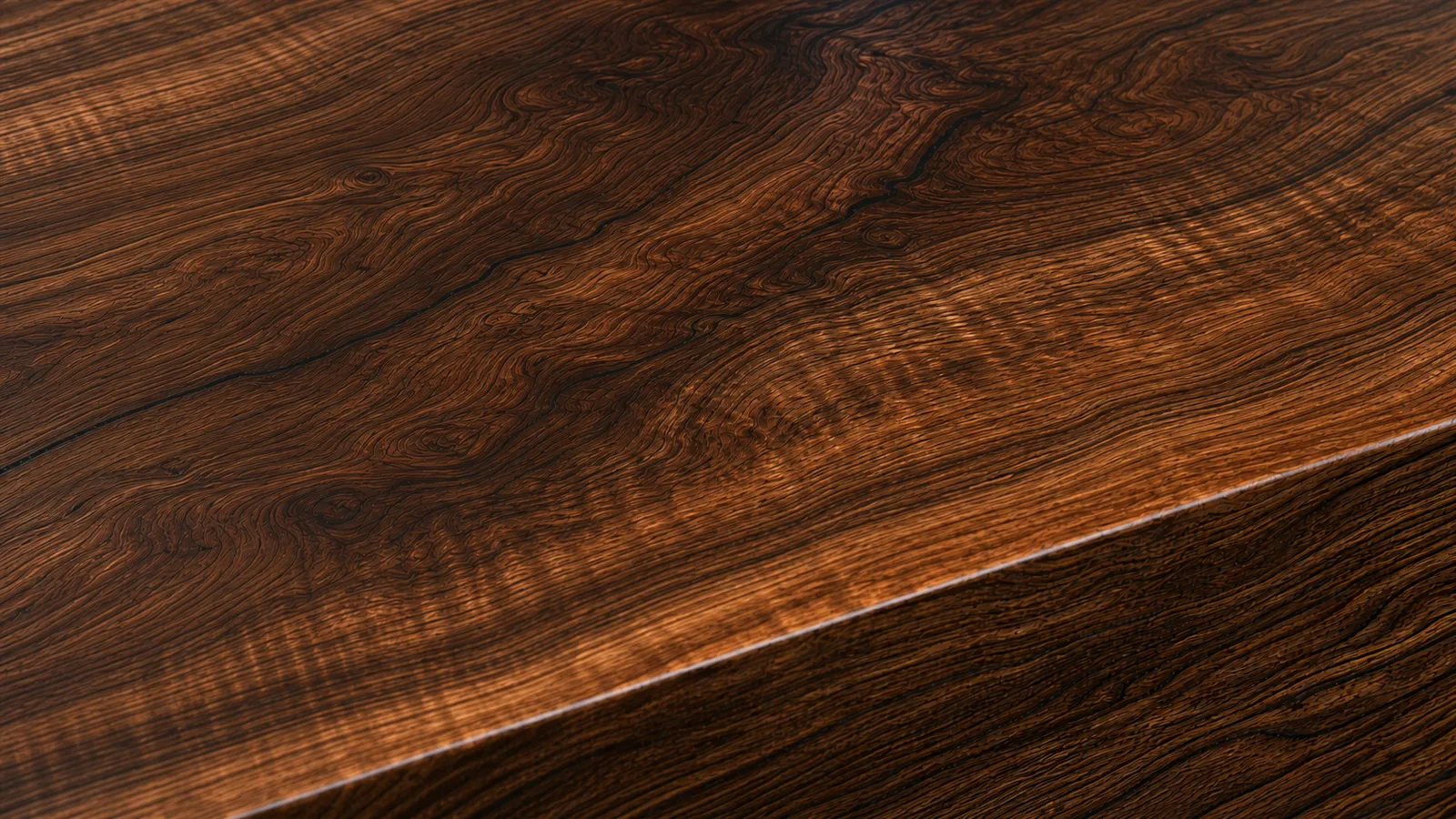
Claro walnut grown in the Pacific Northwest. Marbled figure, color that runs from pale gold to deep chocolate with purple casts, and trunk widths that yield full single-slab tops no eastern walnut can match.
Oregon black walnut is the name the trade gives to walnut grown in the Pacific Northwest. Most of it is claro walnut, Juglans hindsii, a species with a different history and a different face than the eastern black walnut most furniture is built from. The trees grow larger, the color runs wilder, and the boards come off the saw in widths eastern walnut rarely reaches.
The heartwood ranges from pale warm brown to deep chocolate, and it rarely stops there. Claro carries casts of gray, purple, and red through the grain, with darker streaks that move across a board like weather. Wood cut near the graft line of old orchard trees, where English walnut was joined to claro rootstock, shows the marbled figure this species is known for: browns, golds, and near-blacks that no two boards repeat. The sapwood is nearly white, and the contrast is sharp.
Straight grain is common. Irregular grain is the prize. Curl, crotch, and burl figure appear in claro more often than in its eastern cousin, and the medium texture polishes to a satin finish under oil. At 1,130 on the Janka scale it is slightly harder than eastern black walnut, with the same honest workability.
These are big trees. Trunks of three to five feet are common, which is why Oregon black walnut is the answer when a commission calls for a full-width top in a single slab. One tree, one surface, no seams. The Arc, our single slab dining table, is built from claro walnut.
We bring Oregon black walnut in from the Pacific Northwest for the commissions that call for it, kiln-dried and selected board by board. If the piece you have in mind wants a single slab, a live edge, or figure with real drama, this is usually where the conversation starts. If you know what you want, we find it. If you are not sure yet, we help you discover it.

Every piece that leaves our shop is finished one of two ways, and the choice is yours. We offer a 2K polyurethane spray finish applied in our commercial spray booth, or a hand-rubbed oil finish using Odie's Universal Oil. Both are exceptional finishes. They simply offer different things, and understanding the difference helps you care for your piece properly.
The 2K polyurethane finish is applied in our dedicated commercial spray booth, a capability that most small custom furniture shops simply do not have. The result is a surface that is hard, consistent, and highly resistant to moisture, heat, and daily use right from the start. It requires less ongoing maintenance and is well suited to households with children, heavy everyday use, or clients who prefer a more set-it-and-forget-it approach to care. For day-to-day cleaning, wipe the surface with a soft damp cloth and dry it promptly. Avoid harsh chemical cleaners. The finish will perform beautifully for many years without any reapplication.
The hand-rubbed oil finish is a different experience entirely. We finish these pieces with Odie's Universal Oil, a food-safe, non-toxic hard wax oil that penetrates the wood rather than sitting on top of it as a film. The result is a surface that feels alive under your hands. You are touching the wood itself, not a coating over it. The finish deepens and enriches the grain in a way no spray finish can replicate, and it becomes more beautiful with age and use.
An oil finish does ask a little more of you over time. Once a year, or whenever the surface begins to look a little dry or flat, a light maintenance coat of Odie's Universal Oil is all it needs. Apply a small amount with a soft cloth, work it into the surface, allow it to set for roughly 45 minutes to an hour, then buff off any excess with a clean dry cotton cloth until the surface feels dry to the touch. Allow the piece to rest for 24 to 48 hours before subjecting it to standing liquids. That is the full extent of the maintenance required. For everyday cleaning, wipe with a soft dry cloth or a lightly damp one as needed.
Regardless of finish, use trivets and felt pads under anything hot or rough, and avoid leaving standing water on the surface for any length of time. Keep your piece out of prolonged direct sunlight to prevent uneven lightening of the wood over time.
If you have any questions about caring for your piece or would like guidance on maintenance, contact us. We stand behind every piece we build and are always glad to help.